Most Python learners hit the same wall: they watch tutorials, read documentation, and work through exercises, but weeks later, the concepts have evaporated. The culprit isn't lack of effort—it's the absence of a deliberate retention strategy. While the programming community obsesses over which framework to learn next, cognitive science has quietly demonstrated that one low-tech practice dramatically improves long-term retention: structured note-taking.
The challenge isn't whether to take notes, but how to take them in a way that transforms passive consumption into active learning. Real Python's recent guide addresses this gap by proposing a systematic approach to capturing Python concepts as you learn them, with particular emphasis on handwritten notes alongside digital tutorials.
Why Manual Note-Taking Outperforms Digital Alternatives
The preference for handwritten notes isn't nostalgia—it's neuroscience. When you type notes, you're essentially transcribing, engaging primarily motor memory. Writing by hand forces cognitive processing: you must understand a concept well enough to summarize it in real-time, creating what researchers call "desirable difficulty."
A 2014 study from Princeton and UCLA found that students who took longhand notes performed significantly better on conceptual questions than laptop note-takers, even though the laptop users recorded more words. The act of handwriting creates stronger neural pathways because it requires interpretation rather than verbatim capture. For programming concepts—which demand understanding relationships between syntax, logic, and application—this distinction matters enormously.
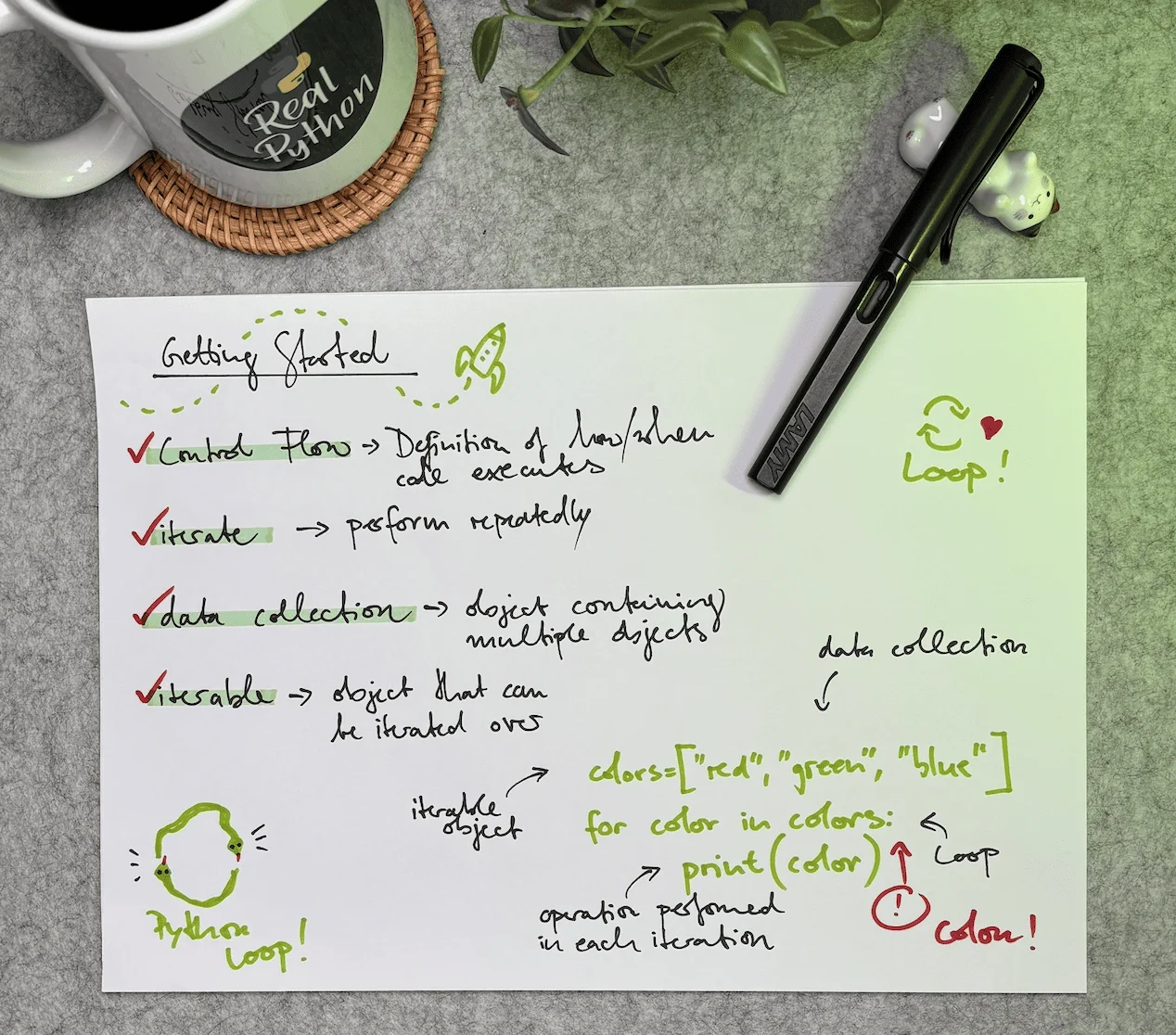
The practical implication: when learning Python's for loops or list comprehensions, writing "iterates through sequence, assigns each element to variable" in your own words creates deeper encoding than copying code snippets into a text file. You're building mental models, not just archives.
The Structural Approach: From Skimming to Synthesis
The guide recommends starting with a reconnaissance pass—scanning major headings before diving into content. This mirrors how experienced developers approach unfamiliar codebases: understand the architecture before examining individual functions. For a tutorial on Python for loops, this means noting the progression from basic syntax to advanced techniques like async iteration before reading a single paragraph.
This pre-reading phase serves two purposes. First, it activates prior knowledge, helping your brain identify where new information fits within existing mental frameworks. Second, it creates anticipation, which cognitive psychologists have linked to improved attention and retention. When you know a section on "common pitfalls" is coming, you read earlier sections with that context in mind.
What Separates Effective Notes From Transcription
The critical error most learners make is treating note-taking as documentation. They copy code examples verbatim, transcribe definitions, and create what amounts to a inferior duplicate of the original tutorial. Effective notes do something different: they capture your understanding, not the author's explanation.
For Python concepts, this means recording three distinct elements. First, the core mechanism: "for loop assigns each item in iterable to variable, executes code block." Second, the mental model: "like processing each customer in a queue." Third, the gotcha: "modifying list while iterating causes skipped elements." These three layers—syntax, metaphor, and edge case—create a complete learning artifact.
The worksheet approach Real Python provides structures this process, preventing the common trap of writing too much or too little. Too much, and you're transcribing rather than processing. Too little, and your notes lack the detail needed for future reference. The framework acts as training wheels until the habit becomes automatic.
Bridging the Gap Between Tutorials and Real Code
One underexplored aspect of programming note-taking is the transition from learning to application. Tutorial code runs in controlled environments with clear inputs and expected outputs. Production code involves ambiguous requirements, incomplete data, and integration challenges. Your notes should build this bridge.
When studying Python for loops, don't just note how to iterate through a list. Record when you'd choose a for loop over a while loop, when list comprehensions become less readable than explicit loops, and how for loops interact with Python's iterator protocol. These contextual notes transform reference material into decision-making guides.
This approach also helps identify knowledge gaps. If you can't articulate when to use enumerate() versus range(len()), you've found a concept that needs deeper exploration. Your notes become a diagnostic tool, revealing not just what you've learned but what you haven't.
The Retention Multiplier: Spaced Review
Taking notes creates value, but reviewing them multiplies it. The spacing effect—one of the most robust findings in learning science—shows that information reviewed at increasing intervals becomes nearly permanent. Your Python notes aren't meant to be written once and filed away; they're the foundation for a review system.
A practical implementation: review your for loop notes the day after taking them, then three days later, then a week later, then monthly. Each review takes minutes, not hours, because you're refreshing existing neural pathways rather than building new ones. This transforms note-taking from a one-time activity into a learning system that compounds over time.
The worksheet format supports this by creating consistent structure across topics. When all your Python notes follow the same pattern—major concepts, code examples, personal insights, questions—reviewing becomes faster because you're not decoding different organizational schemes.
Where This Approach Falls Short
Handwritten notes have limitations that deserve acknowledgment. They're not searchable, can't be version-controlled, and don't integrate with development environments. For code that you'll reference frequently—utility functions, API patterns, configuration templates—digital notes or a personal code library make more sense.
The handwritten approach works best for conceptual learning: understanding how Python's data model works, when to use generators versus lists, or how decorators modify function behavior. These are the foundations that make you a better programmer, distinct from the reference material that makes you a faster one. Both matter, but they serve different purposes and benefit from different capture methods.
Building a Sustainable Learning Practice
The real test of any learning technique isn't whether it works in theory but whether you'll actually do it consistently. Handwritten notes have an advantage here: the barrier to entry is trivially low. No app to configure, no system to set up, no decisions about folder structure or tagging schemes. Grab paper, start writing.
This simplicity matters because learning Python is already cognitively demanding. Adding complex note-taking systems creates friction that makes you less likely to take notes at all. The worksheet approach succeeds by reducing decisions: you know what to capture, where to write it, and how to organize it. The cognitive load goes toward understanding Python, not managing your note-taking system.
As Python continues evolving—with pattern matching, type hints, and async features expanding the language—the ability to learn effectively becomes more valuable than memorizing current syntax. Note-taking isn't about creating a personal Python reference manual; it's about training your brain to absorb, process, and retain new programming concepts efficiently. That skill remains relevant regardless of which Python features emerge next.