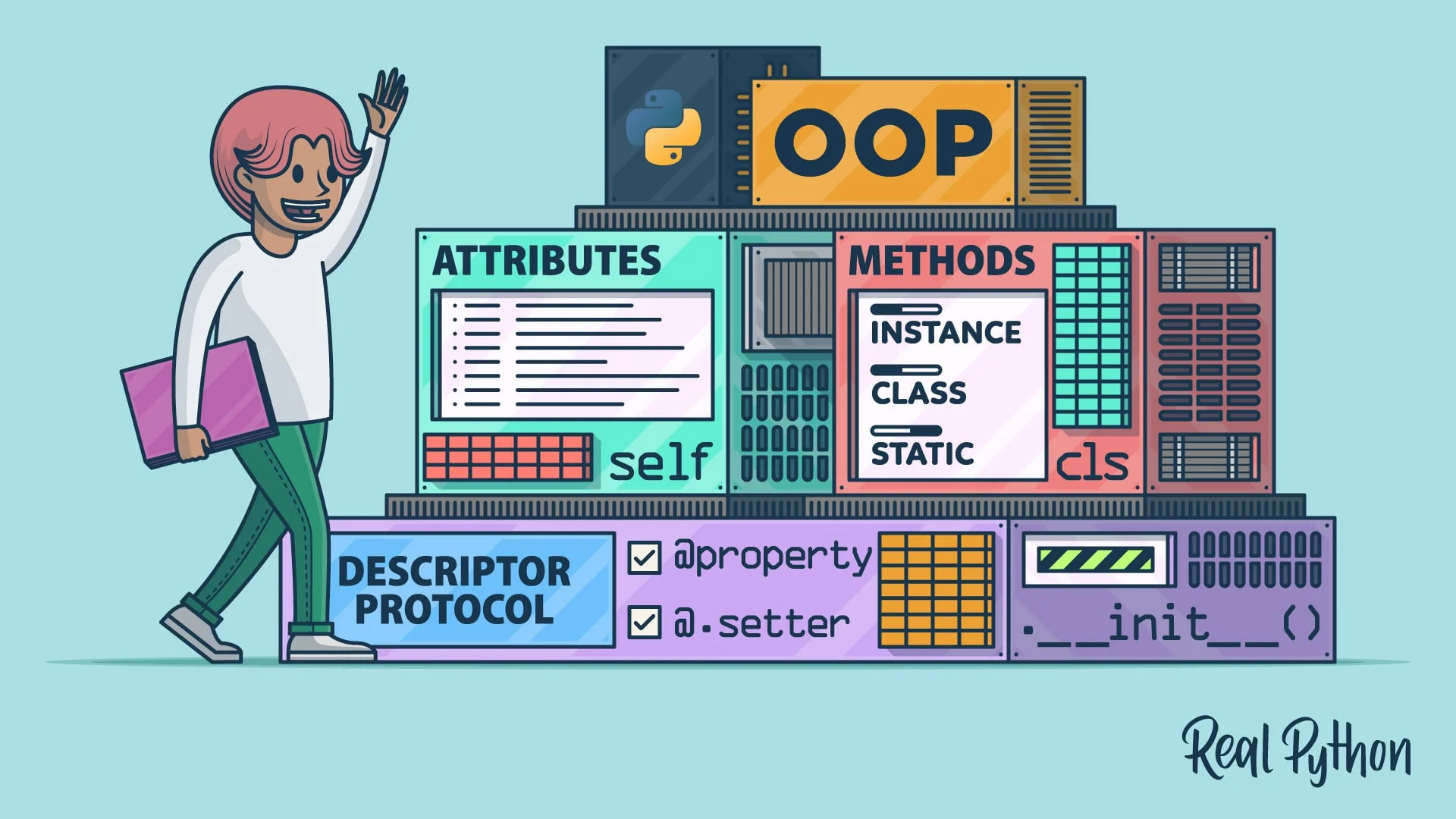
Python classes serve as templates for creating objects that combine data and functionality. By using the class keyword, you define attributes that hold information and methods that define actions, allowing you to instantiate multiple objects from a single blueprint. Classes form the cornerstone of object-oriented programming (OOP) in Python, enabling you to structure code that's modular, reusable, and easier to maintain.
Key concepts covered in this tutorial:
- A Python class acts as a reusable template specifying the attributes and methods that objects will possess.
- Instance attributes store data specific to individual objects, whereas class attributes are shared among all instances.
- Python supports single and multiple inheritance, facilitating code reuse through hierarchical class structures.
- Abstract base classes (ABCs) establish formal contracts that subclasses are required to fulfill.
- Classes facilitate polymorphism, enabling different object types to be used interchangeably when they share common interfaces.
This tutorial assumes you're comfortable with Python variables, data types, and functions. Prior exposure to object-oriented programming (OOP) concepts is helpful but not required, as all essential principles are explained throughout.
Get Your Code: Click here to download your free sample code that shows you how to build powerful object blueprints with classes in Python.
Take the Quiz: Test your knowledge with our interactive "Python Classes - The Power of Object-Oriented Programming" quiz. You'll receive a score upon completion to help you track your learning progress:
Interactive Quiz
Python Classes - The Power of Object-Oriented ProgrammingIn this quiz, you'll test your understanding of Python classes, including attributes, methods, inheritance, and object-oriented programming concepts.
Getting Started With Python Classes
Python is a multiparadigm language that embraces object-oriented programming (OOP) through classes, which you define using the class keyword. A class is essentially code that specifies both the data and behavior needed to represent a particular type of object.
Think of a class as an architectural blueprint for a house. The blueprint allows you to construct multiple houses or even an entire neighborhood. Each physical house represents an object or instance created from that blueprint.
Every instance can have distinct properties—color, owner, interior layout—which together constitute the object's state. Instances also exhibit various behaviors: locking doors, opening the garage, controlling lights, watering the garden, and so on.
In OOP terminology, attributes refer to the properties or data tied to a specific object of a given class. In Python, attributes are variables declared within a class to store the information necessary for the class to function properly.
Similarly, methods describe the behaviors that objects can perform. Methods are functions defined within a class that typically manipulate or utilize the attributes of the underlying instance or class. Together, attributes and methods are called members of a class or object.
Classes let you model real-world entities, helping you organize code more effectively and tackle complex programming challenges.
You might create classes to represent people, animals, vehicles, books, buildings, or any tangible objects. Classes also work well for virtual entities like web servers, directory trees, chatbots, or file managers.
Additionally, classes enable you to build class hierarchies, promoting code reuse and reducing redundancy across your projects.
Throughout this tutorial, you'll explore classes and the powerful capabilities they offer. You'll begin by defining your first Python class, then progress to topics covering instances, attributes, and methods.
Defining a Class in Python
To define a class, use the class keyword followed by the class name and a colon, similar to other compound statements in Python. The class body begins on the next indented line:
class ClassName:
<body>
Within the class body, you define attributes and methods as required. Attributes are variables storing the class's data, while methods are functions providing behavior and typically operating on that data.
Note: In Python, a class body functions as a namespace containing attributes and methods. These members are accessible only through the class itself or its objects.
Consider a practical example: suppose you need a Circle class for modeling circles in a drawing application. Initially, your class will include an attribute for the radius and a method to calculate the circle's area:
circle.py
import math
class Circle:
def __init__(self, radius):
self.radius = radius
def calculate_area(self):
return math.pi * self.radius ** 2
Here, you define Circle using the class keyword. The class contains two methods. The .__init__() method holds special significance in Python classes—it's the object initializer that defines and assigns initial values to the object's attributes. You'll explore this method further in the Instance Attributes section.
The second method, .calculate_area(), computes a circle's area using its radius. This example leverages the math module to access the pi constant.
Read the full article at https://realpython.com/python-classes/ »
[ Improve Your Python With 🐍 Python Tricks 💌 – Get a short & sweet Python Trick delivered to your inbox every couple of days. >> Click here to learn more and see examples ]